Boards Bot
Practice oral boards with a real examiner.
Voice in, voice out. A real case, a real grade, every time you sit down to prep.
7-day trial. $10/week after. Cancel anytime.
Seven topics. Twelve board domains. Two rubrics.
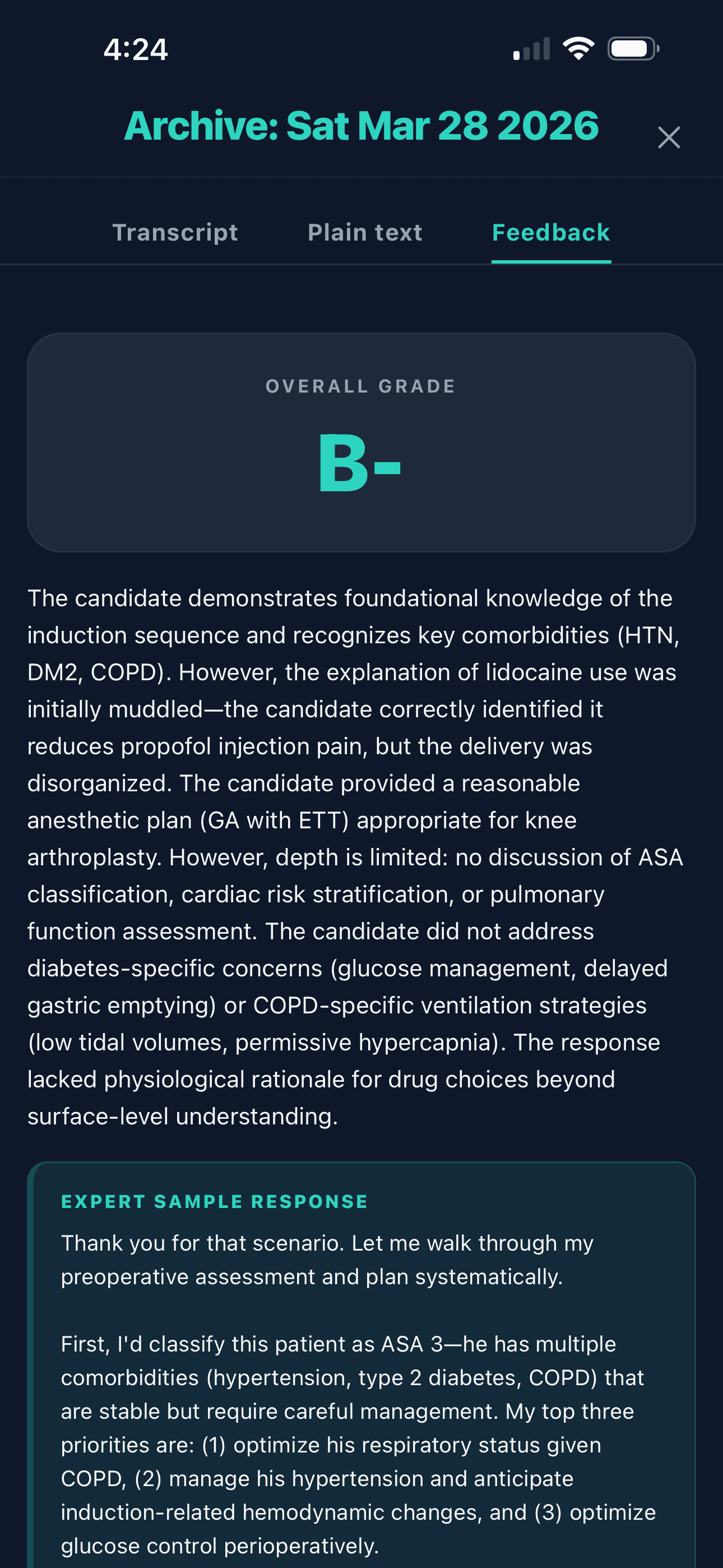
Pick a topic — cardiac, neuro, obstetric, pediatric, vascular, trauma, or general. The examiner runs a case in voice; you respond in voice or by typing. After 30 to 40 minutes you get a grade card: what you got right, what you got wrong, exactly why.
Every weakness is tagged to one of twelve board domains — airway, pharmacology, crisis management, pre-op assessment, and the rest — so you know which area to study next. Choose the lenient rubric if you're building confidence; choose the boards rubric when you're ready for the real ABA standard.
Topic— the clinical system or specialty you'll practice.
Board domain — the skill area we measure in your grading.
The two are orthogonal — you can practice a cardiac case and get a board-domain weakness flagged in pharmacology.
The medicine is fixed. Only the conversation is fluent.
Every case starts from a vetted stem, written from standard references and reviewed by hand. The examiner reads the stem you'd actually get. It doesn't invent a patient.
Follow-ups come from a fixed bank of probe areas built for that case. Pivots stay on the topic you picked. The examiner presses hard — it can't wander into a subspecialty it made up.
Grading runs against an expert reference for that case and a fixed rubric: explicit score bands, and a hard cap if you say something that would harm a patient. The same dimensions the ABA scores.
Everything that can be pinned down, is. The clinical content tracks the literature — not a model's best guess. The model's job is to talk; the cases, the probes, and the answer key are curated, not generated. That's why what your residents practice, and how they're graded, stays accurate.
Curated cases
Stems written from standard references and reviewed by hand. Read verbatim — never generated on the fly.
Rails on the questioning
Follow-ups drawn from a per-case probe bank. Pivots locked to your chosen topic.
Anchored grading
Scored against a per-case expert reference and a fixed rubric, with a hard patient-safety cap.
Does the examiner make up the medicine?
No. Every case is a vetted stem read verbatim. The follow-up areas and the answer key are written from standard references and reviewed by hand. The model controls the wording of the conversation, not the clinical content.
Can it hallucinate a wrong fact into the grade?
Grading runs against a fixed rubric and a per-case expert reference, with a hard cap if a response would harm a patient. The grade is anchored to that reference and the literature, not free-formed.
Is Boards Bot deterministic?
Every part that can be pinned down is. The same vetted cases, the same probe areas, the same rubric, the same patient-safety rules. The clinical content tracks the standard literature, not a model's guess. See how it works.
Why I built this.
I'm a former anesthesia resident. I took the oral boards. I remember scrambling to find attendings willing to run mock cases with me — people who were already post-call and already doing me a favor by showing up.
I noticed something. The residents who passed weren't the smartest ones. They were the ones who got the most reps. The exam was starting to feel less like a test of clinical mastery and more like a test of access.
So I built this. The examiner pushes you the same way the real ones do, and tells you exactly what you got wrong and why, every single time.
A faculty dashboard your program directors will actually use.
Faculty get a live roster of every resident's readiness — grades, recurring weak areas, session history. Targeted question generation against specific gaps. And every resident at the program gets a direct line to me for prep, fellowship, and career questions.
See how it works at your program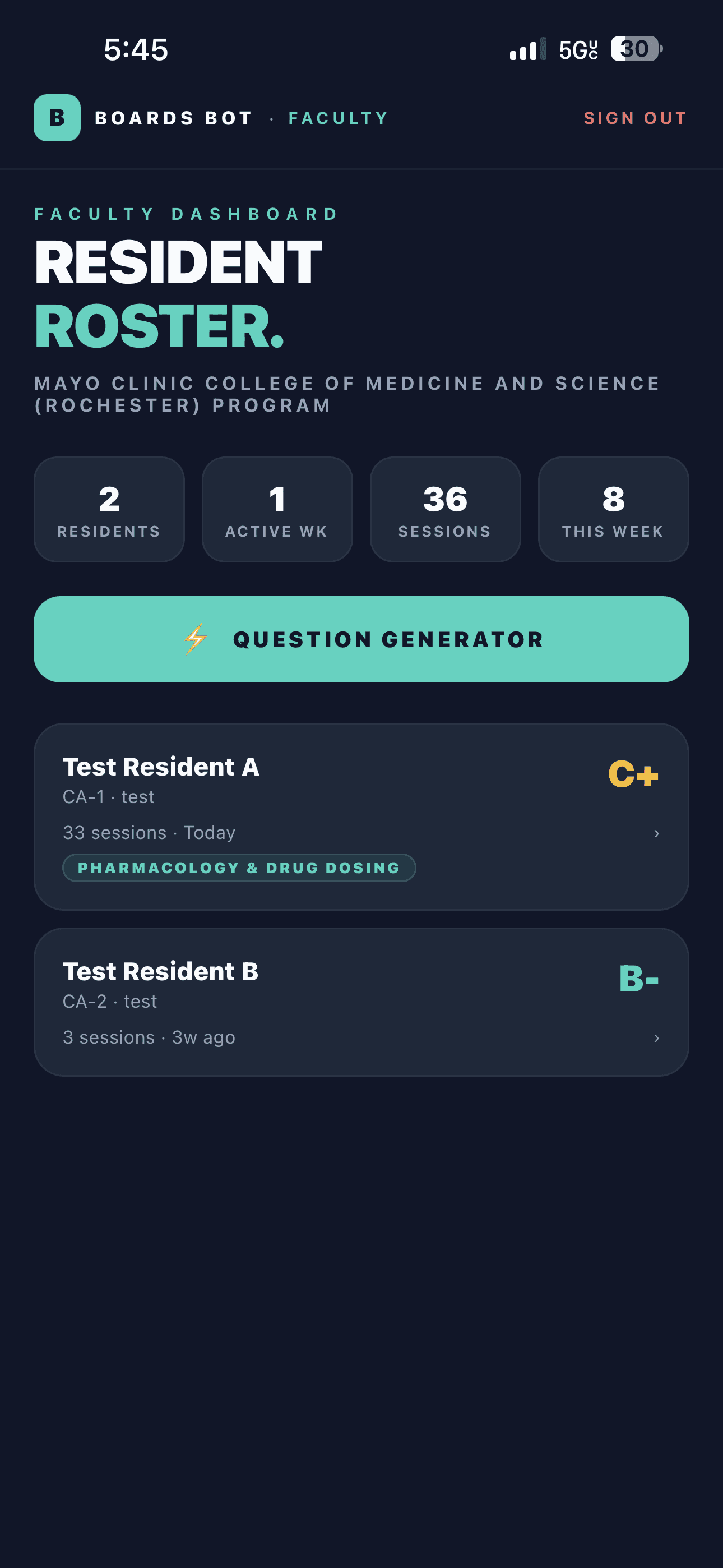
Free for 7 days. Then $10 a week.
No tiers. No upsell. No annual lock-in. If you pass the boards in two months, you cancel after two months. If you need it for six, you stay for six.
Start the trial